

Written by Faramarz Kamali, co-founder of The Viral Vibe Media
Faramarz Kamali is the co-founder of The Viral Vibe Media, a Sydney-based video production and digital marketing agency he runs with his wife, Marjan. Together they specialise in high-impact commercial videography, social media content, and AI-powered video production for Sydney businesses, with a portfolio spanning trades, hospitality, health, and personal-brand clients across the city.
In This Guide
- Beyond the Highlight Reel: Why Strategic Event Video Production Matters
- The Pre-Production Blueprint: How to Plan for Success
- Choosing Your Format: Live Streaming vs. Post-Produced Content
- On the Day: Managing the Production Crew and Talent
- Post-Production and AI: Turning One Event into Months of Content
- Transform Your Event into a Growth Engine
- Frequently Asked Questions
Key Takeaways
- Treat your event as a strategic asset for the brand, not just a day to record and forget.
- Build a proper Run Sheet before the crew arrives, so the moments that matter don't get missed.
- Turn one day of filming into a multi-channel content engine, not a single highlight reel that sits unused.
- Give the crew a dedicated point of contact on the day, so you're free to focus on your guests.
- Get more from your budget by repurposing one hero film into dozens of social clips with AI-assisted editing.
Video marketing is linked to faster revenue growth for a lot of businesses — some studies put the gap at around 49% faster year-on-year, though the number moves depending on which survey you read. Even so, for plenty of Australian brands, event video production still feels like a costly gamble. You know the feeling: the pre-event nerves about the crew missing a key moment, the confusion over lighting and audio specs, the sinking sense that the budget you spent is now sitting on a hard drive, unused.
Your event should be a launchpad, not a digital souvenir. This guide walks through how to turn a single day of filming into a content engine that runs across channels for months — one that builds brand authority and, more usefully, sells. We'll cover how to build a production plan that delivers a genuine suite of social assets alongside the polished hero film. No more just recording the day. Time to make it work harder.
Beyond the Highlight Reel: Why Strategic Event Video Production Matters
A lot of brands treat event video production like a digital scrapbook: record the day, cut a three-minute highlight reel, post it once, done. That's a missed opportunity. Your event shouldn't be a memory — it should be a strategic asset. There's a real difference between capturing a moment and building something that actually performs for the business. For ambitious Sydney brands, one event can fuel months of marketing. Skip the strategy and you're paying for footage that will likely gather dust.
Think of your event as a content engine instead. One day of good filming can produce a hero film, a stack of social clips, and a library of commercial photography. This isn't really about filming the event — it's about the thinking behind it. Approach production with growth in mind and a one-off cost turns into a longer-term investment: something that builds authority and drives sales rather than sitting in a folder marked "2026 event."
Identifying Your Primary Objective
Success starts with clarity. Before the first camera rolls, work out your hero metric. What does a win actually look like — brand awareness, ticket sales for next year, or internal training your team will actually watch? Your objective shapes everything downstream, from crew size to filming style. A gala dinner needs a different look to a technical conference. Line up the production stages with your business goals and the output becomes purposeful, not just footage for the sake of it.
The 'One-Shot' Reality of Event Filming
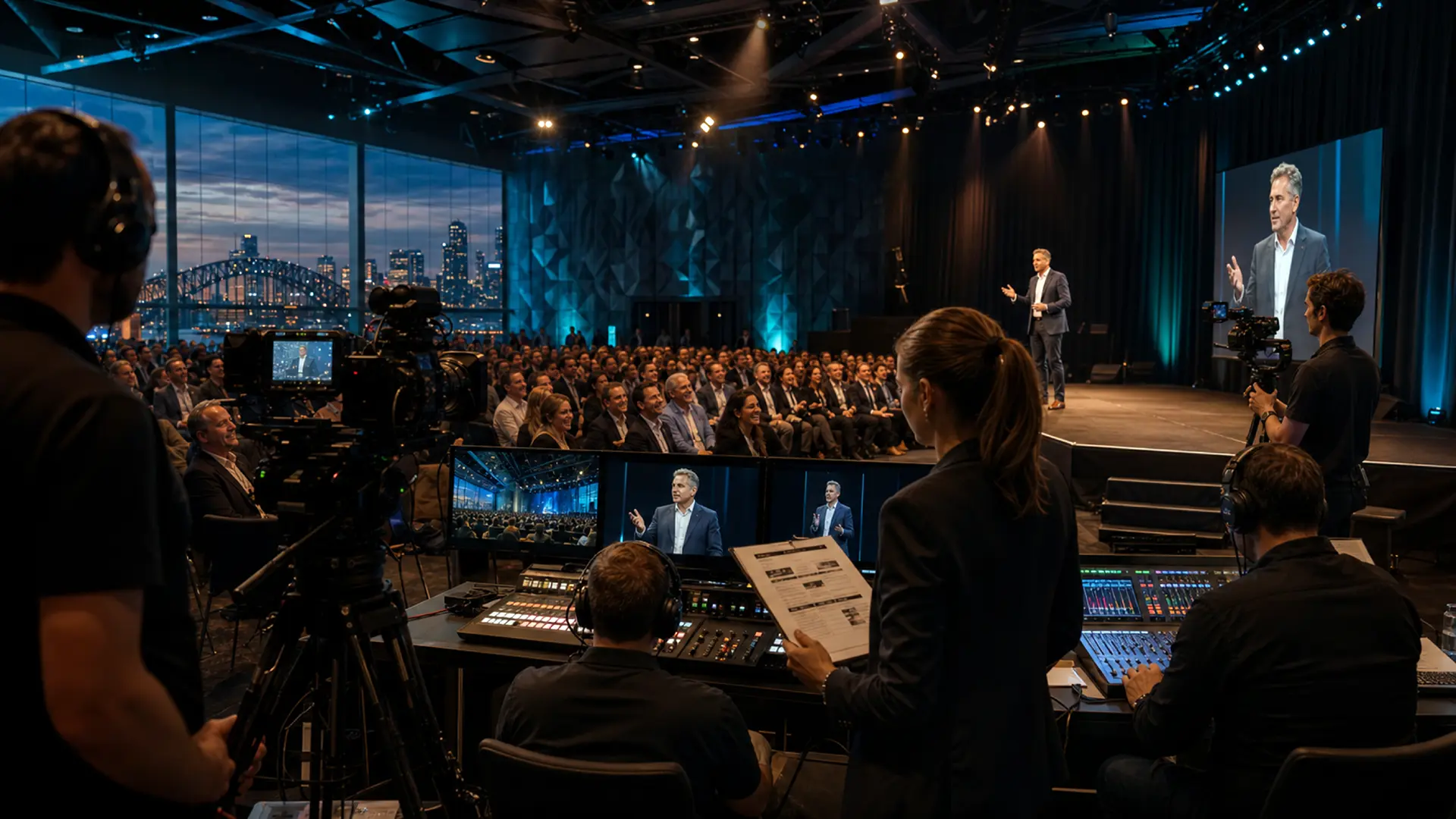
Live events don't offer retakes. If the keynote speaker drops a great line and the camera isn't rolling, it's gone. That one-shot reality is why professional event video production matters. Good crews build in redundancy: spare batteries, multiple memory cards, backup audio recorders. They anticipate lighting shifts and stage movement before they happen. A professional team doesn't just record; they manage the risk quietly in the background, so your most important brand moments still land, whatever chaos is happening in the room.
The Pre-Production Blueprint: How to Plan for Success
Good execution isn't luck. It comes from a solid pre-production plan. Strategy is the foundation, but this phase is where the mechanics get sorted. You need a plan that can survive the chaos of a live room. Serious event video production runs through five steps: strategic discovery, creative briefing, site reconnaissance, technical coordination, and final scheduling. Skip one and you're gambling on a technical problem no amount of editing can fix later.
A clear creative brief is the single most useful thing you can hand your editor. It sets the tone before a frame is shot — whether the team is chasing a fast, high-energy social edit or a slower, cinematic piece. Without it, you're just collecting footage and hoping it cuts together. Good planning means the crew moves with confidence because every shot has a purpose. If you'd like a partner who plans this way from the start, the frameworks at The Viral Vibe Media are built around exactly this.
Mapping the Run of Sheet for the Camera Crew
Your Run of Sheet is the camera crew's bible. Handing it over isn't enough — you need to flag the moments that can't be missed: award winners, surprise speakers, the spontaneous reactions in the crowd. A good crew should know the VIPs on sight. They also need buffer time. Moving three cameras and heavy tripods between rooms takes ten minutes, not two. Schedule too tight and you'll lose the start of the next session while the crew is still walking between rooms.
Audio and Lighting: The Unsung Heroes of Event Video
Audio is the part nobody notices until it's wrong. Crackly or distant sound will undercut even excellent visuals. Your crew should coordinate with the venue's AV team early to get a clean feed straight from the sound desk, so speech comes through clearly without the echo of a big hall. Lighting works the same way in reverse: what feels "moody" to guests in the room often reads as simply dark on a camera sensor. A site visit lets the team light the stage for the lens, not just the room — so your speakers look like experts, not like they're standing in a basement.
Choosing Your Format: Live Streaming vs. Post-Produced Content
Live broadcast or polished post-produced film? It's a real choice, and it shapes how your audience experiences the brand. Do you want the raw energy of the present moment, or a cinematic asset that keeps working for years? It depends on your goals. Live streaming is for "now"; post-production is for "later." More Australian brands are landing on a hybrid of the two.
Budgeting shifts depending on which you pick. Live streaming loads costs into on-site hardware and specialised crew up front. Post-production shifts that spend into the edit suite instead. AI-powered video tools have cut post-production timelines from weeks to hours over the past couple of years, which makes high-end editing more affordable than it used to be. Whichever you choose, the focus stays the same: visual quality and strategic impact.
The Power of Real-Time Engagement with Live Streams
Live streaming is strong for immediate reach — a good fit for product launches or announcements where timing matters most. Roughly three in ten internet users watch at least one livestream a week (the exact figure shifts depending on the survey), which says something about the appetite for real-time content. Pulling this off well in Sydney means a solid technical stack: bonded internet so you don't drop out mid-stream, multi-camera switchers, dedicated encoders. Use live interaction to turn passive viewers into active ones — real-time Q&A works well. A decent chunk of livestream viewers go on to buy a ticket for the next event, though nobody publishes a reliable, consistent figure for exactly how many.
Creating a Multi-Asset Social Media Content Engine
Don't let your event die when the house lights come up. A single highlight reel only captures a small slice of what the day is actually worth. The real value in event video production comes from building a multi-asset content engine — which means planning for vertical video from the start. Your crew should shoot dedicated content for TikTok and Reels alongside the standard 16:9 footage. Grab "vox pops," short interviews with attendees, for authentic social proof on the fly. These small clips often outperform the main film for engagement. Capture the moments this way and one day of filming becomes a library of social media content creation that carries your marketing for months.
On the Day: Managing the Production Crew and Talent
The day arrives. The blueprint is ready. Time to execute. Managing a crew during event video production takes focus you can't expect your lead organiser to have spare — not while they're also handling caterers and VIP arrivals. That's a recipe for missed shots and a stressed-out team. Appoint a dedicated point of contact instead. This person is the bridge: they know the schedule, they know the VIPs, and they're available the moment the crew needs a fast decision. Their job is clearing the path so the creatives can stay on the lens.
Authenticity is worth more than almost anything else here. If your speakers or attendees feel pressured, it shows on screen. Make your talent comfortable — a glass of water, a chat before the red light goes on. Relaxed people tell stories. Nervous people recite scripts. That human connection is what turns an ordinary recording into something worth using as a brand asset. If you want a crew that knows how to draw out genuine moments, The Viral Vibe Media focuses on the person as much as the camera settings.
Your B-roll list matters just as much for the final polish. You want the venue to look full, even if there are empty seats up the back. Encourage the crew to use tighter lenses and creative angles to capture the room's energy. Focus on the handshakes and high-fives — those small moments of interaction are what prove the event was worth being at, and what makes next year's ticket holders feel like they missed out on something real.
Coordinating Interviews and Vox Pops
Don't leave interviews to chance. Find a quiet corner away from the main PA system — clean audio matters for anything you'll use as social proof. When filming vox pops, skip the yes-or-no questions. Ask what stood out about the day, or how a particular session changed someone's thinking. A dedicated producer should shepherd talent to camera so the videographer can stay focused on framing the shot, keeping the momentum up without pulling attendees out of the event itself.
Setting Up the Crew's Home Base
The crew needs somewhere out of the way to charge batteries and store gear cases securely. Sightlines matter too — a tripod shouldn't ever block a paying guest's view of the stage. The rule that holds it all together: the crew should be everywhere and invisible at once, there to add to the experience rather than get in its way. Lock in the best camera positions during the morning setup, before the Sydney public walks through the doors, and the whole day runs more smoothly for it.
Post-Production and AI: Turning One Event into Months of Content
The doors close. The stage sits empty. Most organisers think the job's done at this point — it isn't. This is exactly where your investment in event video production turns from a cost into something that pays for itself. Post-production used to be a slow, manual grind. AI-powered video tools have compressed weeks of editing into hours. That's not just about speed — it's about scale. One event. A dozen-plus clips. A lot more reach than a single video could manage alone.
Our approach at Viral Vibe isn't to hand over a single hero film and call it done — we build a small content ecosystem around it. One event typically yields a cinematic hero film plus a batch of social clips built to perform. We use transcription tools to scan hours of footage for the strongest soundbites, rather than scrubbing through timecodes by hand. That means the best material gets found, cut, and prepped for distribution while the event's still fresh in people's minds.
A premium finish takes more than a good cut. Colour grading and sound design are the layers that separate content that looks "fine" from content that looks expensive — the kind of thing a brand actually wants to be associated with. Pair those technical refinements with decent storytelling and your assets hold attention wherever they land.
Using AI for Rapid Turnaround and Distribution
Speed matters more than it used to. AI-generated captions and vertical cutdowns mean your social content creation is ready to go out almost immediately, and it keeps brand tone consistent across dozens of different assets — a TikTok reel and a LinkedIn post can share the same visual language without extra manual work. Looking ahead, event video is trending toward more personalised clips for individual attendees, putting them at the centre of the brand's story. That level of targeting used to be out of reach; now it's becoming standard for brands that want to lead rather than follow.
Measuring Success: ROI Beyond the View Count
Stop chasing vanity metrics. High view counts look good, but they don't pay the bills. According to SQ Magazine, the large majority of marketers (somewhere around nine in ten) now say video delivers a positive return, though that's only true if you're tracking the right numbers. Watch time and lead generation matter more than views. Are people staying for the whole message? Are they clicking through to register for next year? Good video is one of the more effective tools for selling out your next Sydney event, and it builds a kind of authority a text post can't match. Track the path from a single social clip to an actual ticket sale, and the value of doing this properly becomes obvious.
Transform Your Event into a Growth Engine
Your event is worth more than a date on the calendar. Get the pre-production blueprint right and you cut the technical risk while making sure the moments that matter actually get captured. Do that, and a single day of filming becomes a content engine that keeps building authority and driving sales long after the house lights go back up.
Professional event video production isn't only about documenting what happened. It's about building what comes next. Use AI-powered workflows and storytelling grounded in real results, and a one-off cost turns into a set of social assets that actually do something. That's how brands scale their message without needing to shoot twice as much footage — they just plan the one shoot properly.
We're one of the AI-powered production agencies working across Sydney, and we build content meant to be used, not filed away. Don't let your best moments fade once the doors close. Ready to turn your next event into a content engine? Book a strategy session with The Viral Vibe Media today.
The stage is set. Your audience is waiting.
Frequently Asked Questions
How much does professional event video production cost in Sydney?
Cost comes down to the complexity of your requirements rather than a flat rate. Crew size, the volume of social assets you need, and specialised gear like drones or multi-cam switchers all shift the number. Most brands that get real value focus on the total ROI of turning one event into a multi-month content engine, rather than the day rate alone. It's worth discussing your specific goals so you get a quote that actually reflects your budget and what you're trying to achieve.
How long does it take to get the final edited video after the event?
A polished highlight film traditionally takes around two weeks. AI-powered video tools have compressed that considerably — we can often deliver social snippets and rough cuts within 24 to 48 hours, while the event is still fresh. That faster turnaround means you catch the momentum of the day and keep your audience engaged before it fades, instead of waiting weeks for the standard edit to land.
What is the difference between a videographer and a full production crew?
A solo videographer is a generalist, fine for smaller, lower-stakes gatherings. A full event video production crew brings specialists: directors, sound recordists, multiple camera operators. That matters for high-stakes Sydney corporate events where missing a moment isn't an option. A crew gives you technical redundancy and creative depth that a solo operator simply can't match on their own.
Can you provide a live stream and a highlight reel for the same event?
Yes — this hybrid approach has become the standard for modern brand events. We broadcast the livestream for immediate global reach while simultaneously recording high-bitrate footage locally on cinematic cameras. That gives your remote audience a real-time experience and still leaves us with the material to build a prestige highlight reel afterward. It's an efficient way to get value from both the live moment and what comes after it.
Do I need to provide a script for the event video interviews?
Scripts tend to produce stiff, unnatural performances that don't connect with an audience. We'd rather work from a "talking points" approach — our producers guide the conversation so responses stay authentic and energetic. That method captures genuine passion and better storytelling than reading from a teleprompter ever will.
What happens if the event runs over time? Will the crew stay?
Live events are unpredictable, and we plan for that. Production agreements typically include clear provisions for overtime, so your keynote or awards ceremony gets captured in full even if the schedule slips. We stay in constant contact with your on-site point of contact to manage these shifts as they happen. It's worth discussing potential overruns during pre-production, so the crew can plan battery management and logistics around it in advance.
How do I ensure the video matches my brand's specific style and tone?
Alignment starts in pre-production. We use a detailed creative brief and mood boards to lock in your visual identity before the first camera rolls. Reviewing your existing brand guidelines and social presence helps us make sure the event video production fits your market position — colour grading, music selection, every element built to feel like a natural extension of your brand's voice rather than a generic template.
Have more questions? Check our FAQ.
For more event and production tips, browse our Info Hub.
Keep exploring.
Business Photography Sydney: High-Impact Brand Visuals
Strategic business photography for Sydney brands — swap stale stock-style shots for high-impact visuals that build trust and drive conversions.
Commercial Videography & PhotographyPromotional Video Production Sydney: Engineering Attention in 2026
Stop wasting budget on video that doesn't land. Our 2026 guide to promotional video production in Sydney covers hooking viewers in three seconds and turning that into real results.
Commercial Videography & PhotographyCorporate Videography in 2026: The Ultimate Guide to High-Impact Brand Storytelling
A practical guide to corporate videography for Sydney businesses — how to turn expensive-looking video into brand stories that deliver measurable ROI.
Ready to make this happen for your brand?
Book a free 15-minute strategy call — we'll tell you honestly what it'd take to get results like this.
Book a Strategy Call