

Written by Faramarz Kamali, co-founder of The Viral Vibe Media
Faramarz Kamali is the co-founder of The Viral Vibe Media, a Sydney-based video production and digital marketing agency he runs with his wife, Marjan. Together they specialise in high-impact commercial videography, social media content, and AI-powered video production for Sydney businesses, with a portfolio spanning trades, hospitality, health, and personal-brand clients across the city.
Key Takeaways
- Ecommerce video sells one specific product for one specific placement (a product page, a marketplace listing, an ad), not the brand story as a whole.
- In Sydney, a half-day shoot starts from $1,895 + GST and a full day from $2,995 + GST. There's no fixed "full catalogue" package, so bigger jobs get quoted individually.
- The right format depends on the product: turntable for shape, lifestyle for context, demo for function, UGC-style for paid social.
- Filming a full SKU range without a full-catalogue budget comes down to shot-list discipline and batching. Not a bigger crew.
- A briefing checklist prevents the most expensive mistake: reshoots caused by an undefined product list or a missing hero shot on shoot day.
Open any Shopify product page for a $40 apparel item and count the images. Four, maybe six, all shot against the same white backdrop, all static. The customer still doesn't know how the fabric drapes, what the zip sounds like, or whether the product looks as good in someone's hand as it does on a mannequin. That gap between a still photo and buying with confidence is what ecommerce video closes, and it's exactly the kind of physical detail AI can't generate convincingly yet — see our guide to AI-generated vs AI-assisted video for why hero shots still need a real camera.
For Sydney online stores, that gap shows up constantly. Product pages with strong photography and no motion at all. A single generic brand video sitting where a 15-second demo should be. This guide covers what actually counts as ecommerce video production in Sydney, real 2026 pricing, how to brief a session so it doesn't need reshooting, and how to get a full product range filmed without a full-catalogue budget.
What Counts as Ecommerce Video
Ecommerce video is any video asset built to sell or explain one specific product, made for a product page, a marketplace listing or a paid ad placement. Not for a company's broader brand story. That's the practical difference from corporate video: a corporate film (culture pieces, leadership interviews, brand documentaries) sells the business as a whole and gets judged on brand sentiment. Ecommerce video sells the item, usually runs under 60 seconds, and gets judged on whether it moves add-to-cart and conversion on the page it sits on.
It also sits apart from testimonial video, which proves trust through a customer's own words rather than showing the product itself in use. Most Sydney online stores end up needing a mix: a small set of hero and demo videos for the top-selling SKUs, shorter cutdowns for paid social, and, if the catalogue is large, a repeatable, lower-cost format that can be applied across dozens of products without a custom shoot for each one.
The Ecommerce Video Types That Move Conversion Rate
Not every product needs the same treatment. A garment benefits from a turntable shot that shows drape and movement; a kitchen tool benefits from a demo that shows it doing its job. The table below is a starting point for matching format to product and placement.
| Video Type | Best Use | Typical Length | Where It's Used |
|---|---|---|---|
| Product demo | Showing a feature or function actually working | 15–30 sec | Product page video block, YouTube |
| Unboxing / how-to | First-use walkthrough, care or assembly instructions | 30–60 sec | Product page, email/EDM, support content |
| 360° / turntable | Apparel, footwear, homewares where shape and detail matter | 5–15 sec loop | Product gallery, marketplace listing |
| Lifestyle / in-use | Product in context, shown with a person or a real setting | 15–30 sec | Hero banner, paid social, landing pages |
| Hero + ad cutdowns | One main film cut into several shorter ad versions | 60–90 sec hero, 6–15 sec cutdowns | Paid social ads, EDM, retargeting |
| UGC-style social ad | Talking-to-camera or handheld, native-feeling for the feed | 15–30 sec | Meta and TikTok ads |
Most stores don't need all six for every SKU. A common approach: one strong hero or demo video for bestsellers and new launches, a turntable for anything where shape or texture sells the product, and UGC-style cuts reserved for paid social, where a polished studio look tends to read as an ad rather than content.
What Ecommerce Video Costs in Sydney
Pricing depends on how many products are being filmed, whether it's studio or on-location, and how many finished edits come out of the shoot. Two packages cover most single-session ecommerce shoots:
| Package | What's Included | Investment |
|---|---|---|
| Half-Day Commercial Video | Up to 4 hours, one Sydney location, one finished video up to 60 seconds, editing/colour/sound/licensed music included, one round of minor revisions | From $1,895 + GST |
| Full-Day Commercial Content | Up to 7 hours, one main video up to 90 seconds plus three short social edits, two rounds of minor revisions, horizontal and vertical delivery | From $2,995 + GST |
| On-Location Filming | One videographer, standard camera/lighting/sound, 2-hour minimum | $299/hour + GST |
| Editing & Post-Production only | No filming — for stores that already have raw footage. Advanced animation or motion graphics quoted separately | From $149/hour + GST |
For a large or multi-location catalogue (think 50-plus SKUs, several product categories, or a shoot that needs more than one day) there's no fixed "full catalogue" package. Those jobs get custom quoted against the actual product list and shot count — cost genuinely scales with the number of setups, not the number of hours in the room. The most reliable way to get an accurate number is to bring a real SKU list to the quote. Current packages and rates are kept up to date on the pricing page, worth checking before budgeting since packages get refined as the market moves.
Studio, On-Location or Remote/UGC
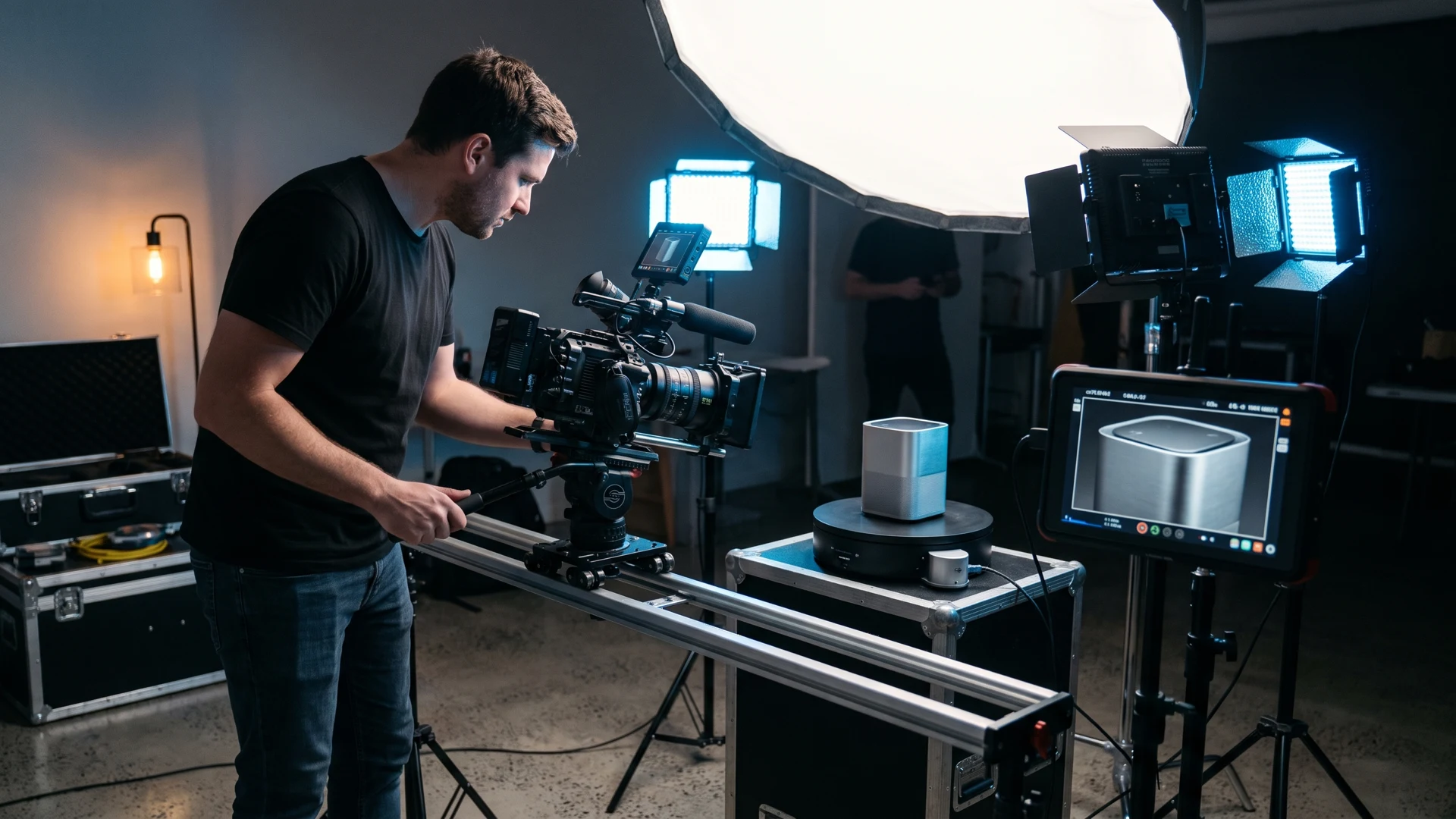
The right setting depends on what the product needs to prove. A studio setup, with controlled light, a clean background and a locked camera, is the standard choice for turntable and demo shots where consistency across dozens of SKUs matters more than atmosphere. It's also usually the fastest way to get through a large batch, because nothing about the setup changes between products.
On-location filming earns its cost when the product needs a real environment to make sense: furniture in a styled room, outdoor gear on a trail, food in a kitchen. It's billed by the hour with a 2-hour minimum, which suits a tighter, single-product shoot better than a large catalogue run.
Remote or UGC-style content is a different category again. Shorter, handheld, native-feeling clips built specifically for paid social rather than the product page. These work best treated as their own line item rather than an add-on to a studio day, since the brief, pacing and delivery specs differ from a hero video.
How to Brief an Ecommerce Video Shoot
The single most expensive mistake in ecommerce video is arriving on shoot day without a locked product list. A tight brief costs nothing and prevents most reshoots. Before booking, have these ready:
- A final, numbered SKU list — not "roughly 30 products," an actual list with names or codes.
- One reference video or product page per format you want (demo, turntable, lifestyle) so the crew knows the target look before arriving.
- Physical samples of every product on the list, on site before filming starts. Clean, and in sellable condition.
- A decision on aspect ratio and delivery: horizontal for the product page, vertical for Stories and Reels, square for feed. Confirmed before the edit, not after.
- Any brand guidelines: logo placement, colour grading direction, on-screen text style, background colour or set requirements.
- A single point of contact who can approve shots on the day, so the crew isn't waiting on an email reply mid-shoot.
None of this needs to be a formal document. A shared spreadsheet with the SKU list and reference links covers most of it.
Filming a Full Product Range Without Blowing the Budget
Catalogues in the 20-to-500 SKU range are usually where budget becomes the real constraint, not creative ambition. The way to keep cost proportional is batching: lock one camera position and one lighting setup, then move products through it rather than resetting the scene for each one. A turntable rig set up once can run through a large number of small products in sequence far faster than filming each as a separate scene.
Grouping by shot type rather than by product category also saves time. Film every turntable shot in one pass, then every demo shot in a second pass, rather than doing a full demo-plus-turntable-plus-lifestyle sequence for each individual item. The other lever is triage: not every SKU needs a custom video. Bestsellers and new launches justify a dedicated demo or lifestyle shoot; the long tail of a catalogue is often better served by the same repeatable turntable format applied consistently, which is also what keeps per-SKU cost down.
Full-range jobs don't fit neatly into a half-day or full-day package, so they're the case where a custom quote against the actual shot list gives the most honest number, not an hourly guess. Check current package rates before scoping a full-range job, then bring the SKU list to the conversation.
Where These Videos Get Used
The same finished video rarely lives in only one place. A well-shot product video typically gets deployed across:
- Product pages — embedded in the main image gallery on Shopify or a similar platform, usually as the first or second asset a shopper sees.
- Marketplace listings — platforms such as Amazon support video within product listings, though upload requirements and formats are set and updated by each marketplace directly, so check the current help documentation for the specific platform before preparing final files.
- Paid social ads — Meta and TikTok both support video ad formats, with vertical and square cuts generally performing better in-feed than a straight horizontal crop. Exact size and length limits change periodically, so confirm current specs in the platform's own ads guidance before locking an edit.
- Email and EDM — most email clients don't autoplay embedded video reliably, so the common approach is a video thumbnail that links out to the hosted video or product page rather than an inline player.
Delivery specs differ by platform and change over time, so it's worth building the brief around one high-resolution master file that can be re-cropped and re-compressed per placement, rather than asking for a fixed export list upfront.
Choosing an Ecommerce Video Partner
Most Sydney video agencies can point a camera at a product. The differences that actually affect the outcome tend to show up in the questions below:
- Can they show turntable or demo work for a catalogue similar in size to yours? A single hero video and a 40-SKU batch job call for different production approaches — ask to see the latter if that's what you need.
- What's included in the quoted price versus billed separately? Revisions, licensed music, colour grading and multiple aspect-ratio exports should be clear before booking, not discovered in the final invoice.
- How do they handle a large SKU list logistically? A clear batching plan (shot order, styling breaks, sample handling) is a sign the studio has actually run range shoots before, not just single-product ones.
- What's the turnaround from shoot day to delivered files? Get a specific timeframe in writing, especially if the video needs to go live for a launch date.
- Who owns the raw footage afterward? If you'll want to re-cut for future campaigns without rebooking a shoot, confirm you'll receive final files, not just the compressed exports.
A partner who asks for your SKU list and target platforms before quoting is usually a better sign than one who quotes off a single phone call.
Frequently Asked Questions
How much does ecommerce video production cost in Sydney?
A half-day shoot (up to 4 hours, one finished video up to 60 seconds) starts from $1,895 + GST. A full day (up to 7 hours, one main video plus three social edits) starts from $2,995 + GST. Larger catalogue jobs are custom quoted. Current rates are listed on the pricing page.
How long does an ecommerce video shoot take?
A single product with a few formats can be covered in a half-day (up to 4 hours). A larger SKU range typically needs a full day or more, depending on how many shot setups are required. This is best scoped against the actual product list rather than estimated in the abstract.
What's the difference between testimonial video and ecommerce video?
Testimonial video builds trust through a customer's own words about their experience. Ecommerce video shows the product itself: its features, scale, texture or use. It's built specifically for a product page, listing or ad rather than a review format.
Is animation better than live-action for product video?
It depends on the product. Live-action suits anything where real texture, movement or human interaction matters — apparel, food, tools. Animation or motion graphics suit abstract features, software, or products that are hard to film clearly, and are quoted separately from standard filming rates.
How many videos come out of one shoot?
A half-day package delivers one finished video up to 60 seconds. A full-day package delivers one main video up to 90 seconds plus three short social edits. Larger batches (multiple SKUs, multiple formats) scale with the SKU list and are quoted accordingly.
Will the video work on Shopify and Amazon, and in a paid social feed?
The production should account for aspect ratio (horizontal for product pages, vertical for Stories/Reels, square for feed) at the brief stage. Individual platform specs are set and updated by each platform, so confirm current requirements on the platform's own help documentation before final export.
Have more questions? Check our FAQ.
Keep exploring.
Best Social Media Content Agency Sydney: Your 2026 Guide to High-Impact Production
Once your product videos are cut down for ads, this guide covers how to brief and vet the agency running them on Meta and TikTok.
Promotional Video Production Sydney: Engineering Attention in 2026
Hero videos and ad cutdowns live or die on the first few seconds. This piece breaks down how to hold attention in a paid feed.
Business Photography Sydney: High-Impact Brand Visuals
Product video works best next to strong stills. See how a matched photography set rounds out a product page gallery.
Ready to film your product range?
Bring your SKU list and target platforms to a free 15-minute call, and we'll scope a shoot plan and quote around your actual catalogue.
Book a Strategy Call