
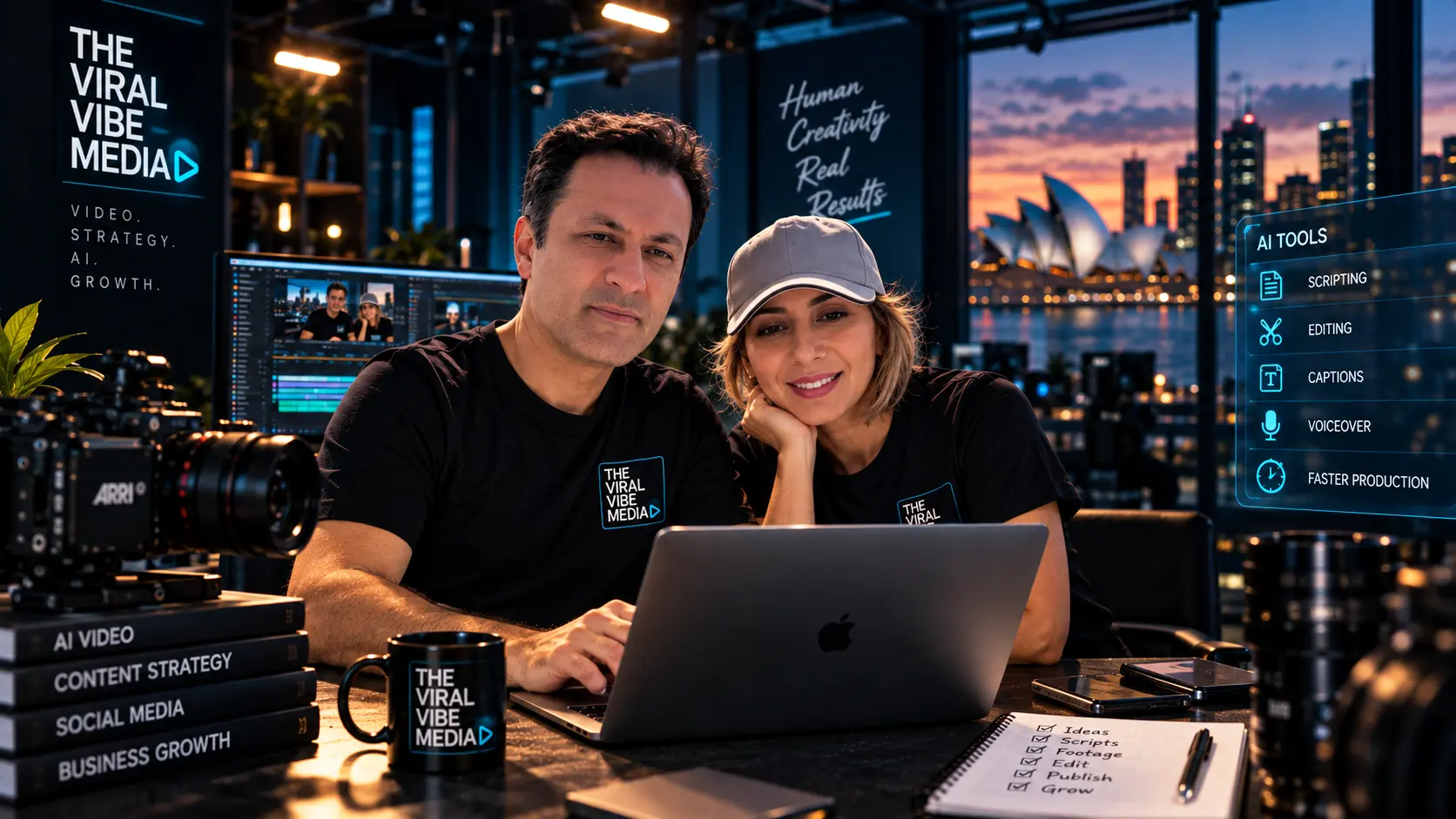

Written by Faramarz Kamali, co-founder of The Viral Vibe Media
Faramarz Kamali is the co-founder of The Viral Vibe Media, a Sydney-based video production and digital marketing agency he runs with his wife, Marjan. Together they specialise in high-impact commercial videography, social media content, and AI-powered video production for Sydney businesses, with a portfolio spanning trades, hospitality, health, and personal-brand clients across the city.
In This Guide
- AI-Generated vs AI-Assisted Video: The Difference That Actually Matters
- What the Trust Data Actually Says
- Australia's New Disclosure Rules, in Plain English
- The 80/20 Split: What Actually Suits AI-Assisted Production
- What AI-Assisted Video Actually Costs
- How We Actually Run an AI-Assisted Project
- Where This Leaves You
- Frequently Asked Questions
Key Takeaways
- "AI video" covers two very different things: a tool inventing footage from a prompt, and a human production sped up with AI tools. The trust risk sits almost entirely with the first one.
- Australia now has real, enforceable disclosure obligations for AI-generated content, with actual penalties attached.
- Most of what a business posts is a good fit for AI-assisted production. Proof-driven content especially still needs a camera in the room.
- Independent testing puts real numbers on when viewers can and can't tell the difference — it's not a matter of opinion.
- The businesses getting burned right now are the ones that used AI to remove the human, not to speed the human up.
Aerie ran an anti-AI campaign in early 2026. So did Equinox. So did Almond Breeze. Three brands, three separate categories, all making the same bet: that calling out "AI slop" and proving a human made the ad would win more trust than the AI itself would save in production cost. That's not a marketing gimmick. It's a response to a real, measured shift — Australian and international consumers are actively wary of AI video right now, and businesses that treat "AI video" as one single thing are walking into that backlash without meaning to.
Here's what actually separates the businesses getting burned from the ones quietly saving real money: whether AI replaced a person, or sped one up. This guide breaks down AI video content for business into what's actually different, what Australia now legally requires you to disclose, which parts of your content calendar it actually suits, and what it costs.
AI-Generated vs AI-Assisted Video: The Difference That Actually Matters
One means a tool invented what's on screen: a synthetic presenter, a clip generated from a prompt, footage of someone who doesn't exist. The other means real footage of your real business, produced faster because a tool handled the scripting, the voiceover pass, the first edit or the captions. They get lumped together under "AI video," and that's the mistake. The trust research below is almost entirely about the first category.
The tools on the market reinforce the split. Platforms built for synthetic presenters and full-generation clips are a genuinely different product from AI tools that speed up editing a real shoot. A growing part of Sydney's "AI video" market leans hard into the first camp — hyper-realistic AI characters, fully generated visuals, avatars standing in for actors. That's a legitimate product for some use cases. It's also the exact category carrying the trust risk covered next.
Where we sit: every video we produce with AI assistance is still built around your real people, your real space, your real product. AI speeds up the script draft, the voiceover pass, the first edit, the captions. A person reviews every stage before it ships. Nobody watching the finished video is looking at a synthetic version of your business.
What the Trust Data Actually Says
Consumers notice AI video, and a large share of them react badly to it — but the reaction is softer when the brand is upfront about using it. This isn't a hunch. It's measured, and the numbers are blunter than most agencies want to admit.
A Harris Poll cited by Clutch.co found 78% of consumers say AI makes ads feel less authentic, and 63% say they're less likely to buy from a brand using AI-generated ads. The generational split is sharper still: 54% of Gen Z say they'd lose trust in a favourite brand that used AI for most of its marketing, against 32% of Boomers. If your customers skew younger, this isn't a fringe concern.
What's changed in 2026 is that the backlash now has a name: "AI slop". Real brands are positioning against it rather than around it. The pattern researchers point to isn't "AI bad, no AI good." It's that the brands taking damage used AI to subtract human craft and pocket the difference, while the ones holding up used it to add something — speed, reach, more variants — without anyone noticing the join. The same research puts a number on the upside too: 65% of consumers are open to AI-generated content from a business, provided the business is transparent about using it. Disclosure isn't a legal box-tick here. It's most of the difference between the two outcomes above.
Australia's New Disclosure Rules, in Plain English
Australia moved from guidance to enforceable rules on AI disclosure through 2026, and the penalties for getting it wrong are no longer trivial. None of this requires a lawyer to understand — it requires knowing it exists, which most small business content on this topic doesn't cover.
| Rule | What it actually requires |
|---|---|
| ACMA broadcast rule (Feb 2026) | Disclosure is mandatory when a synthetic AI voice hosts a radio program or news broadcast. |
| Privacy Act amendment (from 10 Dec 2026) | Disclosure required when automated systems are used in ways the Act covers. |
| AANA Code of Ethics §2.7 | Advertising must already be "clearly distinguishable as such" — a standing rule AI content doesn't get an exemption from. |
| ACCC "AI-washing" enforcement | Misleading claims about AI capability or AI use are now a flagged enforcement priority, separate from disclosure itself. |
The financial exposure moved at the same time. As of March 2026, maximum Australian Consumer Law penalties for a corporation are the greater of A$100 million, three times the benefit gained from the breach, or 30% of turnover during the relevant period — up from A$50 million previously. None of these rules are aimed at a business quietly using AI to speed up an edit of real footage. They're aimed squarely at the AI-generated end of the spectrum this guide opened with — another reason the distinction in the first section isn't academic.
The 80/20 Split: What Actually Suits AI-Assisted Production
Most of a typical content calendar suits AI-assisted production well. Proof-driven content especially doesn't, and forcing it usually shows. Independent blind testing backs this up rather than leaving it to opinion.
In blind comparisons, roughly 73% of viewers couldn't distinguish high-quality AI-assisted video from traditionally produced content, and the same research found around 80% of typical small-business content — product clips, onboarding videos, promo shorts, feature updates — works well with AI assistance in the mix. That's exactly the territory our own service covers: AI-drafted scripts, voiceover in multiple languages, an automated first editing pass, instant subtitling, and variants of the same core asset built for different audiences.
The other 20% is where a camera in the room still matters more than speed. Testimonials and case studies rely on a real customer's unscripted delivery — read our guide to testimonial and case study video for why that specific format resists automation. Property walkthroughs depend on a real sense of scale and light that's covered in our real estate video production guide. Physical product demonstrations are the same story: texture, sound, how something actually moves, which is why our ecommerce video guide leans on real filming for hero shots even where AI speeds up everything around them.
What AI-Assisted Video Actually Costs
Traditional Australian corporate video production and pure AI-generated tools sit at opposite ends of a wide cost range, and AI-assisted production sits between them — closer to traditional quality, at a meaningful chunk of the saving. We haven't published a fixed price list for this service yet, so what follows is market context, not a quote.
Traditionally produced corporate video in Australia typically runs AUD 3,500 to 10,000 per finished video on a subscription model, or AUD 7,500 to 30,000+ for one-off project work, with day rates commonly landing between $4,950 and $7,450. Pure DIY AI generation tools sit far below that — entry plans from roughly $20 to $50 a month, scaling to $80–$300+ for higher-resolution, higher-customisation tiers. Neither number tells you what AI-assisted production costs, because it isn't either of those services: it's professional production with AI doing the time-consuming middle steps, not a subscription tool you run yourself and not a full traditional day rate for every step. If you want an actual number for your project, that's what the strategy call is for.
How We Actually Run an AI-Assisted Project
Every project runs through five stages, and a person makes the call at every one of them — AI drafts, nobody ships a draft. This is the actual process, not a simplified version of it.
It starts with a creative brief, understood properly before any tool touches the project — the message and the audience come first, not the software. From there, AI drafts the script and storyboard, but a person reviews and rewrites before it goes any further. Voiceover and the first editing pass both lean on AI for speed, checked against the brief rather than approved automatically. Captions and any translated versions get generated instantly for whichever markets the video needs to reach. Then it goes through human review: a final pass by our team, with AI contributing suggestions on length, thumbnail and hook rather than making the call itself.
That order matters more than any individual step. AI never sees the brief and ships something straight to you — a person is in the loop at the point that actually decides whether something represents your brand, not just at the end when it's harder to unwind a bad call.
Where This Leaves You
AI video isn't one decision. It's several smaller ones: what gets AI-assisted and what still needs a camera, what you disclose and when, and whether the tool you're using is speeding up a real production or replacing it. Get those right and you're in the 65% who benefit from AI video without the backlash. Get them wrong and you're the next brand running an apology campaign.
Ready to work out which parts of your content actually suit AI assistance?
Frequently Asked Questions
Do I have to disclose that a video used AI in Australia?
It depends on what the AI did and where the video runs. A synthetic AI voice hosting a broadcast segment is already a mandatory-disclosure case under ACMA's February 2026 rule. Advertising more broadly already has to be "clearly distinguishable as such" under AANA Code of Ethics §2.7, and the ACCC treats misleading claims about AI use, what it calls "AI-washing," as an active enforcement concern regardless of the specific format. If AI assisted the editing of real footage of your real business, the disclosure question is a different and lower-stakes one than if AI generated the presenter or the footage itself.
What's the actual difference between an AI avatar and AI-assisted editing?
An AI avatar is a synthetic presenter — the "person" on screen doesn't exist, or is a digital stand-in for someone who does. AI-assisted editing is a real person, filmed normally, with AI speeding up the script draft, the voiceover pass, the first cut or the captions. The finished video shows your actual business either way; the only question is how much of the production step in between was accelerated by AI versus done by hand.
Will my customers be able to tell a video used AI?
For AI-assisted production of real footage, usually not — independent blind testing found around 73% of viewers couldn't tell the difference from fully traditional production. For fully AI-generated content, meaning a synthetic presenter or invented footage, the research is more mixed. Some formats hold up fine. Close-ups and high-stakes messaging are where viewers are most likely to notice something's off.
What kind of video should never be made with AI?
Anything where the proof is the point. A testimonial only works because it's a real customer, in their own words, with the hesitations left in — an AI version defeats the purpose before it's even published. Property walkthroughs and physical product demonstrations have the same problem: the thing you're actually selling is a real sense of scale, texture or how something moves, and that's exactly what's hardest to fake convincingly.
How much does AI-assisted video cost compared to a traditional shoot?
We haven't published a fixed price for this service, because it depends heavily on scope. As a general market reference, traditional Australian corporate video production runs from roughly $3,500 up to $30,000+ depending on the project, while pure DIY AI tools run from about $20 to $300+ a month. AI-assisted production sits between those, since it's professional production work with AI speeding up specific stages rather than either extreme — a strategy call gets you an actual number for your project.
Is AI-assisted video a good fit for ecommerce, real estate or coaching businesses?
For the repeatable stuff, yes — product clips, listing highlights, course promos, onboarding videos, explainer content. That's most of what these businesses need to post regularly. Where it's a weaker fit: the specific formats that rely on unscripted proof or physical presence, covered above and in our dedicated guides for testimonial video, real estate video and ecommerce video.
How long does an AI-assisted project take?
Faster than a fully traditional shoot-to-delivery timeline, mainly because the scripting, first edit and captioning stages move quicker — but the brief, human review and any reshoot of real footage still take the time they need. We'll give you a project-specific timeline once we know the brief.
Still have questions before booking? Check our FAQ.
Keep exploring.
Testimonial & Case Study Video Production Sydney: A Buyer's Guide
Why proof-driven video is one of the formats AI assistance can't shortcut, and what it actually costs to get right.
Commercial Videography & PhotographyReal Estate Video Production Sydney: The Complete Guide for Agents and Developers
The complete guide for agents and developers selling more than a floor plan.
Commercial Videography & PhotographyEcommerce Video Production Sydney: The 2026 Guide to Product Videos That Convert
Product videos built to convert on the product page, not just look nice.
Ready to make more, without making more work?
Book a free 15-minute strategy call. We'll tell you honestly whether AI assistance actually fits what you're trying to do.
Book a Strategy Call